

In today’s competitive retail landscape, it’s crucial to utilize every advantage available to stand out from the crowd. Pricing plays a significant role in consumer purchasing decisions, making it essential to have a robust pricing strategy that leverages an organization’s data for success. The concept of dynamic pricing is especially intriguing in this regard. With the growth of ecommerce, especially during the COVID-19 pandemic, online comparison shopping has become more frequent and accessible. As we enter a post-pandemic world, pricing will only increase in significance. By incorporating dynamic pricing strategies into your retail operations, you can stay ahead of the game and inspire customer loyalty.
What is Dynamic Pricing?
Before we go further into explaining how retailers can drive profitable growth, we need to examine the meaning of dynamic pricing. Ecommerce businesses can benefit from dynamic pricing, a flexible pricing strategy that uses big data to determine the best price point for products. By analyzing sales volumes, competition, and market trends, business owners can stay competitive and increase profits.

This approach goes beyond simply changing prices based on market fluctuations and also includes competitor analysis. Dynamic pricing uses data to price products rather than relying on fixed costs, and the more data analyzed, the better the optimal prices will be. This means that pricing is based on advanced analytics about the product, buyer, and competitors, not just stock levels.
Dynamic pricing is an incredibly useful tool that can adapt to market changes seamlessly. With this feature, users can input their product costs into their Prisync account. By doing so, the SmartPrice rules can be established based on the product costs and competitive prices to determine the best pricing for each item.
You can easily export these SmartPrice suggestions through the user panel or via integrations such as Shopify, Magento, or API. Businesses can also opt for automatic repricing of products if they use our integrations. This feature can help companies stay ahead of their competition and increase their profits.
How Dynamic Pricing Works on Prisync?
You can set rules for your SmartPrice suggestions or manage existing ones created by you. These rules can be for all products or for a specific product, brand, or category, depending on your competitors and product costs. SmartPrice will be displayed on the product page and in Excel exports. For optimal and profitable SmartPrice suggestions, make sure to enter the product cost – the amount you spent to buy or produce the product, not the sales price.
Check out this video for a tutorial on creating SmartPrice rules.
Set up Dynamic Pricing Rules
As market conditions change, it’s important to make timely adjustments, and automation can help with that. Sitting in front of a computer all day to adjust prices isn’t practical, so building an in-house automation system or using a dynamic pricing tool is necessary. While creating your own engine gives you more control, it requires technical expertise and maintenance. Using easy-to-use and affordable dynamic pricing software is often the best choice for most situations.

So, how to implement dynamic pricing?
With our software, you can position yourself anywhere you want by simply entering your data. If you have a great supplier discount, you can now lower your price and attract more customers. Let’s look at the common dynamic pricing examples:
Enter your cost, desired profit margin, and your desired position (such as cheapest or 5% cheaper than the cheapest). However, determining your profit margin can be challenging, as there is no fixed recipe for it. Dynamic pricing strategies rely on optimization, so you need to continuously test prices.
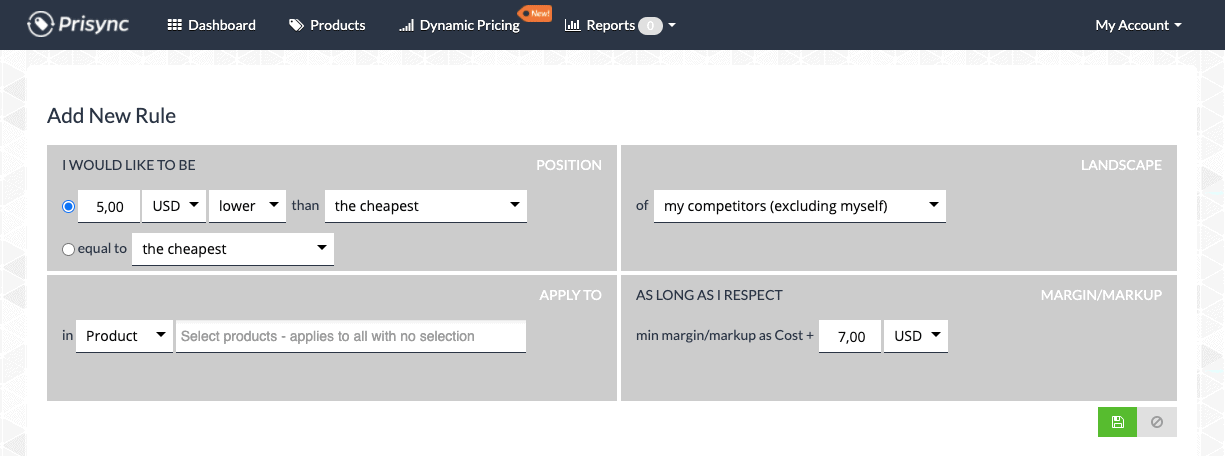
For example, if your cost is $29 and the cheapest competitor sells the same product for $45, you can try pricing it at $35, $38, $43, and so on. There are countless price points between your cost and your competitor’s price, and testing them all is the only way to know their demand. You will find that even the slightest price changes can significantly affect demand, and there is always room for improvement.
Conclusion
In summary, incorporating dynamic pricing strategies in the retail industry has numerous advantages, such as increased revenue, profit margins, and customer satisfaction. Although it may seem overwhelming, getting started is simple if you have the necessary data. If you’re eager to learn more, schedule a meeting with us today!


