

AI is everywhere. As a retailer, you are probably looking for more ways to incorporate AI into your workflow, whether to increase your visibility, generate more traffic, optimize your sales operations, improve customer relations, and, most importantly, increase your sales potential. But the bar doesn’t stop there; there is more to do than putting simple prompts for artificial intelligence to follow. That’s where the term agentic comes into play. Let’s start simple: agentic AI means that the tool you are using is capable of taking autonomous actions to deliver the desired output on your behalf. One of the most beneficial uses of an agentic AI tool for a retailer could be figuring out how to price products without spending so much time and effort, and agentic pricing can be the solution. Let’s dig deeper into what agentic pricing is and how AI can change your ecommerce pricing strategies.
How Did We Get Here From Manual to Agentic Pricing?
Ever since commerce began with human bargaining, the value of the product has mattered, and money was invented to make trade easier. After that, pricing a product fairly and profitably becomes a necessity for merchants to sell their goods to consumers. You can see how manual pricing dates back to the history of commerce, from standalone shops to department stores; and finally, with the development of the internet, ecommerce has been the thing lately.
Ecommerce has created many opportunities for merchants, but they come with a big challenge: setting prices that will lure customers to their online stores. Now that customers can compare prices with a couple of clicks, pricing optimization tools have become essential helpers for retailers. As these early pricing software advanced, it became more capable of managing prices, with human intervention, of course. Advanced competitor price monitoring allows users to set rules to better position themselves in their market and achieve the most profitable results, and it offers powerful reporting capabilities.
As we are in the AI age, price optimization has reached a new level at the moment, as AI pricing agents can act upon this competitor price tracking data and reports to protect merchants’ profit margins. As BCG’s publication about ‘Overcoming Retail Complexity with AI-Powered Pricing’, merchants who have used AI-powered solutions have increased gross profit by 5% to 10% while also sustainably increasing revenue and improving customer value perception.
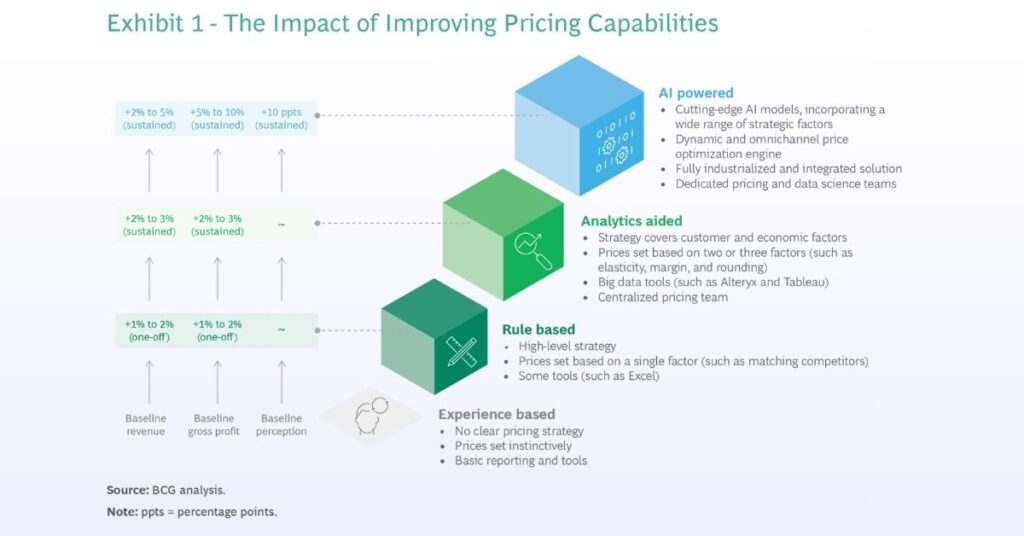
Let’s look at what agentic pricing is and how it works for ecommerce businesses.
What Is Agentic Pricing?
Agentic pricing means using an autonomous pricing agent to handle pricing in ecommerce instead of manual processes. If you are using AI pricing tools, that’s already better than manually adjusting prices. What standard AI needs right now is a specific prompt that presents a dataset and a problem to solve, so it can function properly. To further benefit from AI, you need to analyze and adjust your pricing strategy based on the information you receive. So, it is up to you to see the trends and act based on these predictions.
Moreover, traditional Saas tools can integrate AI into pricing rules to facilitate the process. Whereas with agentic pricing, once you have granted permissions, agents work like a pricing tool manager, and if you establish your pricing goal in the first place, agentic pricing removes that middle step, your pricing strategy is adjusted, and the necessary steps are taken by agents without further intervention.
Why is Using AI in Ecommerce Important?
In today’s reality, people are using AI more and more to discover products. Adobe’s insights show that AI traffic to US retailers rose 393% in Q1 of 2026, increasing their profits and revenue, while 39% of survey respondents said they used AI for online shopping, and 85% said it improved their experience. The statistics show that people are relying more on AI in their purchasing decisions, and better optimization in terms of pricing will definitely put you at the top of AI bots’ listings. Better visibility means higher conversion rates and the potential for returning customers if you have equipped your store with the necessary optimizations and have dynamic pricing in place.

What Agentic Pricing Can and Cannot Do?
What Agentic Pricing Can Do?
Agentic pricing can adjust your prices based on several factors, such as competitor prices, demand, desired profit margin, seasonality, and inventory status, just like dynamic pricing tools, but autonomously. But how does it differ from mighty dynamic pricing? It operates basically like a dynamic pricing tool and reacts to changes in the market, but agentic pricing goes a bit further in terms of execution. Dynamic pricing updates your product prices based on rules you define, while agentic pricing might take action on its own without intervention, both working in alignment with your business objectives.
What Agentic Pricing Can’t and Shouldn’t Do?
What it can’t and should not do is to take advantage of the situation where being competitive is not necessarily a good thing. For example, let’s say you sell hand sanitizers. During emergencies or catastrophic moments, the price of necessities may increase, and when the agent also increases your product prices to be competitive, you can lose your fair pricing, and these practices may cause price gouging. Price gouging may raise ethical concerns and erode customer trust in your brand. Even though agentic commerce makes sense a lot of the time, in this case, autonomous AI should be overridden to maintain fair pricing.
Another case could be the opposite situation, where one merchant lowers their product prices, and subsequent price drops can create a race to the bottom and significant revenue loss. Also, if you have poor data to begin with, you may expect problems to arise with agentic pricing executions, and you can already rely on tools like Prisync for its accuracy. To eliminate errors and ethical issues, human supervision and intervention may be necessary at times.
Even though the improvement in ecommerce seems groundbreaking and advanced, agentic technologies are just beginning to be implemented. Merchants need to be cautious in their next business steps to avoid jeopardizing their customers’ trust and security. Also, staying informed about cybersecurity statistics is crucial when implementing AI systems that process customer data and payment information.

How AI Is Changing Ecommerce Pricing Strategies?
First of all, AI can interpret market signals much better than a human, whereas a pricing person needs to evaluate the data at hand and decide which strategy to take. Of course, humans need to be involved in major market strategies, such as entering a market, launching a new product, or offering a discount, but everyday tasks are much simpler and faster with AI. Because AI continuously scans and scrapes thousands of SKUs, any immediate change can be detected and reacted to by a pricing agent.
Speed is a major factor here. AI can process vast amounts of data in seconds, making predictions and taking actions based on inventory, competitor moves, and demand shifts, which eventually help merchants protect not only their margins but also their competitiveness. This also allows pricing teams to make other important business decisions, such as omnichannel pricing strategies, price localization, or improvements to brand value, to nudge customers to upgrade to a higher tier.
Lastly, the learning curve is much faster than a human’s, making pricing systems highly comprehensive and helpful in supporting pricing teams’ pricing strategies. So much so that the latest McKinsey survey shows 65 to 85 percent of organizations expect to adopt gen AI or agentic AI in pricing over the next one to three years, up from just 10 to 30 percent today.
What Do You Need for Agentic Pricing?
One successful outcome of using an agentic AI ecommerce agent is to gain a higher ROI after the initial implementation. However, to increase your revenue, you need to ensure the data the agent processes is accurate and clear, or the results may not appear as you expect, and, worse, you may not even realize the source of the problem. Since competitor price monitoring is at the center of agentic pricing, your pricing agents need a benchmark to execute every pricing decision.
So, before implementing agentic pricing, make sure you have clear pricing data, predefined pricing objectives, profit margin goals, human oversight to prevent errors, and a reliable price monitoring tool to feed your agents with market intelligence. That’s where Prisync fits into your agentic commerce efforts, allowing your systems to rely on accurate price data that actually protects your margins and keeps your prices dynamic.

Conclusion
You might think that agentic pricing is some notion to look forward to, but it is already here, and AI technologies are advancing faster than ever, making it a necessity to keep up. To be part of this AI world reshaping how merchants compete, it is better to act early and implement these technologies. The benefits of agentic pricing are the foundation goals of every business: spending less time on manual decisions, increasing revenue, and achieving better pricing and margins.
However, agentic systems are only as good as the data they process. Essentially, competitor data is what your pricing agents need to feed your pricing strategy, and Prisync helps track prices across thousands of competitors, which is the basis for staying ahead of the ecommerce competition. Prisync not only serves as a reliable tool for your business decisions, but also as a backbone for these agentic tools. Here at Prisync, we track trends and make improvements to our product, just like you, online merchants. So, stay tuned to see what’s next in ecommerce.

