

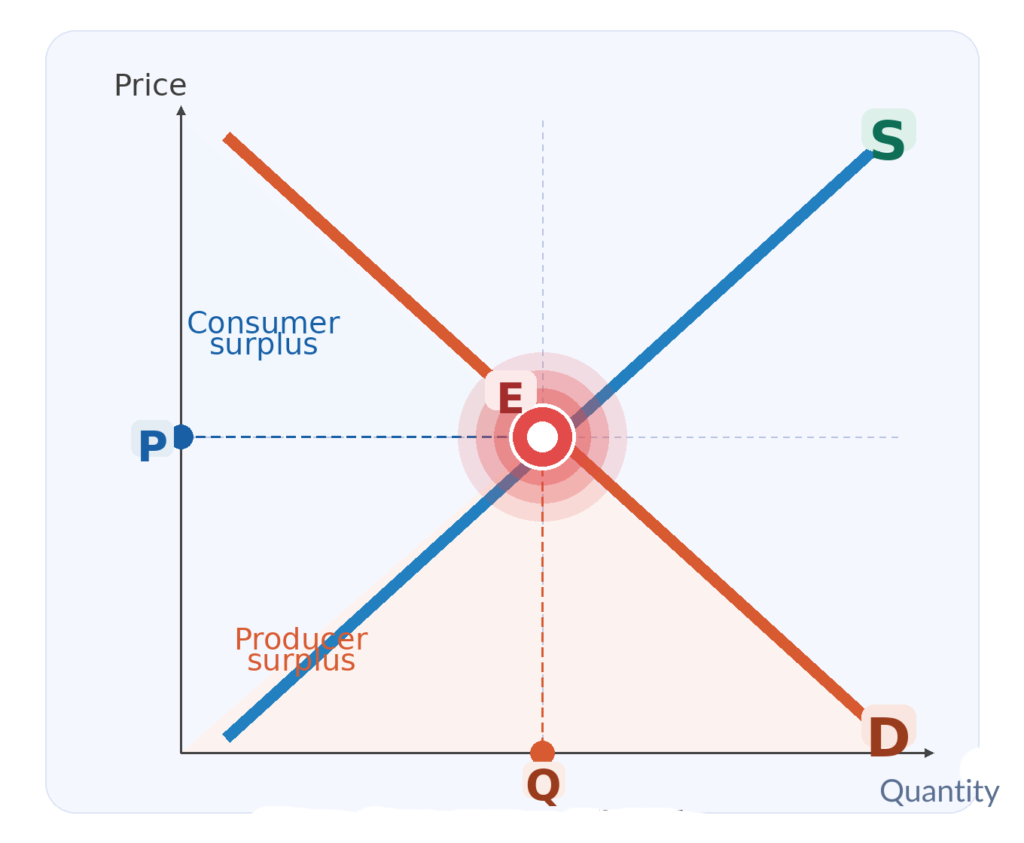
Equilibrium price is the price level at which the supply and demand for a product are equal. At this price point, there is neither a surplus of supply nor a surplus of demand in the market, meaning that the market reaches “equilibrium.”
In other words, the equilibrium price is the quantity of product that sellers want to offer that exactly matches the quantity that customers want to buy.
How is Equilibrium Price Formed?
The equilibrium price arises from the intersection of two fundamental market forces: demand and supply. Demand generally increases as the price falls; supply generally increases as the price rises.
The point where these two curves intersect determines both the optimal price and the optimal quantity sold.

If the price is above the equilibrium level → a surplus of supply occurs
If the price is below the equilibrium level → a surplus of demand occurs
For a simple example, consider a product:
When the price is $50 → High demand, stock runs out quickly
Price: $120 → No sales, stock accumulates
Price: $80 → Sales and stock are balanced
In this case, $80 is the closest point to the equilibrium price for that product.
What Does Equilibrium Price Mean in Ecommerce?
Although the equilibrium price is quite clear in theory, this point is not fixed in ecommerce. Because:
- Competitor prices can constantly change.
- Demand fluctuates according to campaigns, seasons, and trends.
- Stock levels affect pricing decisions.
Therefore, the equilibrium price in ecommerce is a dynamic target point.

Relationship with Dynamic Pricing
Dynamic pricing aims to get as close as possible to the equilibrium price. For example:
When competitors lower prices → the price is optimized to prevent a shift in demand.
The periods where demand increases (e.g., during a BFCM period) → prices are raised to maximize profit.
When stock decreases → the price is increased to balance demand.
From this perspective, the equilibrium price is highly related to dynamic pricing strategies.
Why is it Important?
Understanding the equilibrium price allows ecommerce businesses to:
- Prevent excessive stock accumulation
- Reduce the risk of stock depletion
- Balance maximum sales volume with profit
- Enable more competitive and data-driven pricing decisions