

This article recaps the key insights and discussions from our World Pricing Day 2026 webinar: “The Year Pricing Stopped Being Simple.” You can watch the webinar recording here.
Pricing used to be easier to explain.
Know your costs. Understand your margins. Watch the competition. Set a price.
That playbook hasn’t disappeared. But in 2026, it is no longer enough.
AI shopping agents can compare offers before a customer ever reaches a product page. Costs can change faster than traditional pricing rules can react. International expansion means the same SKU may need a completely different pricing strategy from one market to another. And increasingly sophisticated automation is changing what small pricing and ecommerce teams can actually execute.
That was the central theme of World Pricing Day 2026: The Year Pricing Stopped Being Simple.
And perhaps the biggest takeaway from the day was this:
Pricing is becoming less of a calculation and more of a real-time operating system for ecommerce.
Here are five shifts behind that change.
1. Your customer now has a pricing agent
For years, ecommerce businesses have talked about how easy the internet made price comparison.
AI takes that transparency another step further.
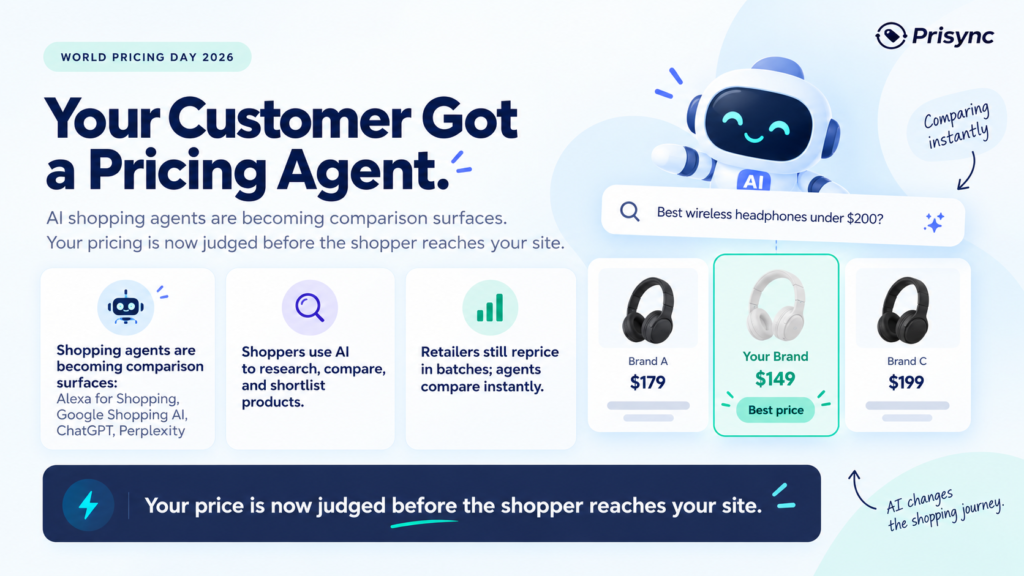
Consumers no longer necessarily need to open ten tabs, search Google Shopping, visit marketplaces, and manually compare retailers. AI-powered shopping tools can increasingly do the research for them: identifying products, comparing sellers, evaluating offers, and recommending where to buy.
That changes an important part of the ecommerce journey.
Your price can now be evaluated before the customer even visits your store.
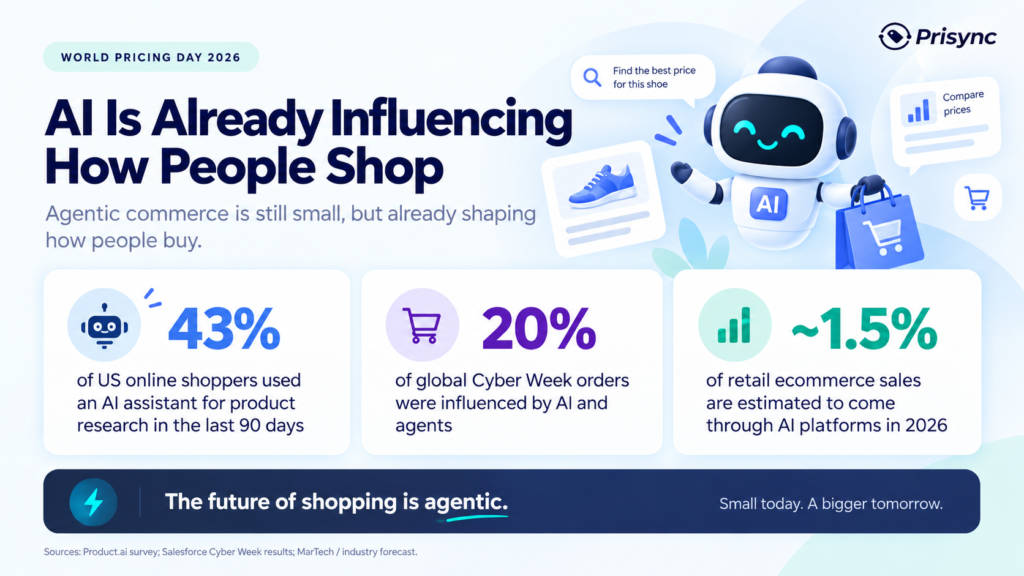
This means pricing competitiveness is no longer only about what a shopper sees on the product page. Retailers need to think about how their prices appear across marketplaces, shopping feeds, search engines, and increasingly AI-powered discovery environments.
The customer didn’t just become better informed.
They gained an agent.
2. Static margin rules are becoming dangerous
The traditional margin floor works well when its assumptions remain reasonably stable.
The problem is that many of those assumptions are no longer stable.
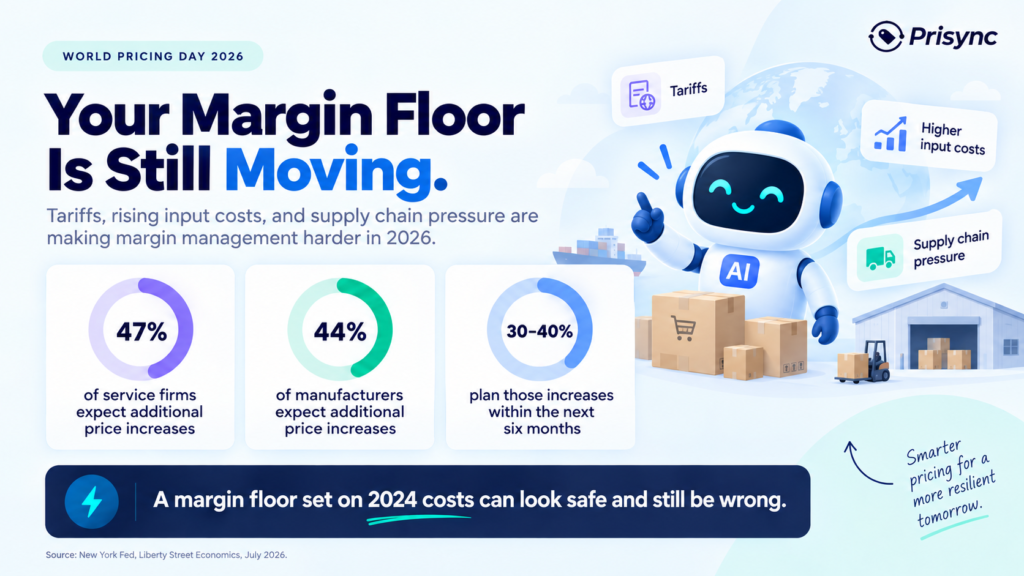
Tariffs, material prices, supplier changes, shipping expenses, payment costs, and other operational inputs can all affect the economics of an SKU.
Todd Staples, Director of Ecommerce at US Supply Company, shared a particularly useful example during our World Pricing Day discussion.
In his industry, a movement in a commodity such as copper can quickly affect replacement costs. A business pricing purely from historical inventory cost may therefore appear profitable on paper while its actual economics have already changed.
The difference today is the speed at which teams can respond.
With competitor intelligence, pricing automation, and AI-supported analysis working together, an ecommerce team can identify a significant change and act on it the same day rather than waiting for the next weekly or monthly pricing review.
But Todd’s approach goes deeper than updating product costs.
His team is increasingly considering expenses such as:
- packaging materials
- credit card fees
- additional warehouse labor
- shipping complexity
- damage rates
- expected returns
Consider a product that technically meets a 20% margin floor.
If its packaging requirements and return rate consume another 5%, that 20% rule is not really protecting a 20% margin.
That is why modern pricing requires a better definition of cost, not simply a better pricing formula.
3. Competitive pricing doesn’t mean competing on everything
Price intelligence creates visibility.
It does not mean retailers should automatically react to every competitor move.
In fact, knowing when not to compete may be just as valuable as knowing when to lower a price.
Todd described three factors that influence that decision.
The first is MAP compliance. If a manufacturer has established Minimum Advertised Pricing, blindly matching a seller that violates MAP can create bigger problems than losing the sale.
The second is the economics of the individual product.
Fighting over fifty cents on an SKU that generates only a few dollars of gross margin may make little sense. But reducing price on a product with significant available margin, strong inventory, low fulfillment costs, and low return rates may be a completely different decision.
And the third is context.
A competitor reducing one SKU is different from an entire category moving down in price.
This is why pricing automation needs guardrails.
The goal isn’t:
Competitor lowered the price → lower ours.
It is closer to:
Competitor lowered the price → understand who changed it, why it matters, whether the product is strategically important, whether our margins support a response, and then act according to predefined rules.
Better competitive pricing isn’t about following the market blindly.
It is about making faster decisions with better context.
4. Global ecommerce needs local pricing
International ecommerce has become easier operationally.
Pricing internationally hasn’t.
A retailer expanding from the UK into Germany, Sweden, Denmark, or another market can technically convert its domestic prices into local currencies within seconds.
But currency conversion is not localization.
Customers in different markets may have different willingness to pay. Competitors change. Distribution costs change. Promotions change. Tax structures can change. Brand perception can change.
So can the optimal price.
A useful way to think about international pricing is to treat each new market almost like opening a new store.
The assortment may be the same.
The competitive reality is not.
Instead of:
One SKU → one global price → currency conversion
international retailers increasingly need:
One SKU → multiple competitive environments → locally optimized prices
This was one of the reasons we recently introduced native Shopify Markets support in Prisync, allowing Shopify merchants to monitor competitors and manage pricing separately across their individual markets.
A German Shopify market, for example, can be benchmarked against German competitors rather than inheriting a pricing strategy built around another country.
As ecommerce becomes more international, market-level pricing intelligence becomes more important.
5. AI won’t replace pricing teams. Speed might.
There is a lot of discussion around whether AI will replace ecommerce and pricing professionals.
We think that framing misses the more immediate change.
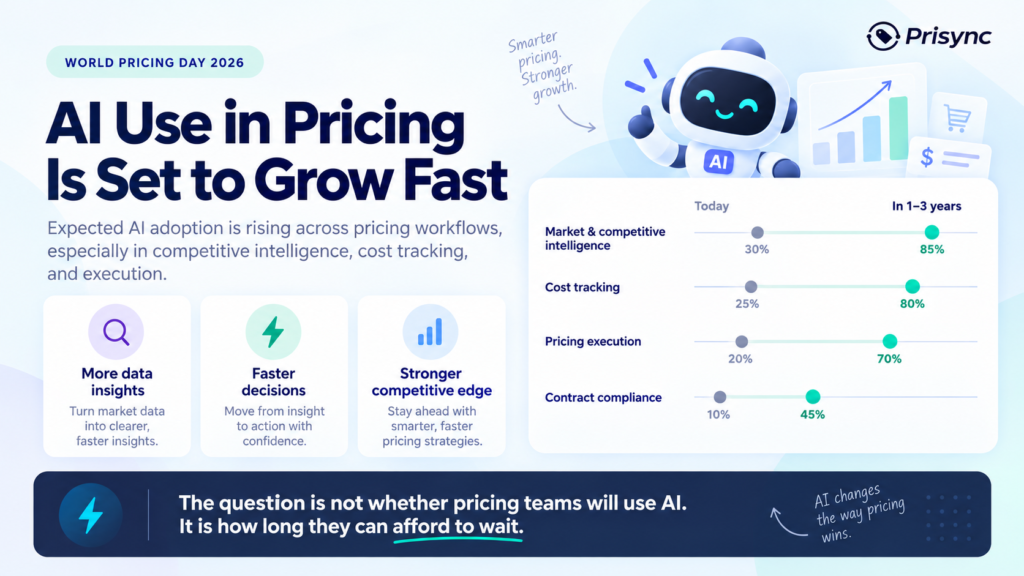
The advantage of AI in pricing is often not that it makes a better strategic decision than an experienced pricing professional.
It is that it can dramatically shorten the distance between information and action.
Todd gave perhaps the best example of the entire webinar.
Using competitor data, automation, spreadsheet analysis, and AI-assisted workflows, he described a pricing process that previously could have required four people working for two days.
He can now handle much of that work in roughly 45 minutes on a Monday morning.
That does not eliminate the pricing professional.
It changes what the professional spends time doing.
Instead of manually collecting competitor prices, checking thousands of products, updating spreadsheets, and repeatedly executing predictable decisions, teams can spend more time determining:
- which products matter
- which competitors matter
- how much margin to protect
- where to use loss leaders
- which price movements require human approval
- how aggressive a strategy should be
- which rules automation should follow
That distinction matters.
The future of pricing isn’t a dashboard that requires someone to babysit it all day.
It is a strategy with clear guardrails that software can execute at a speed humans simply cannot match manually.
So the biggest AI risk may not be being replaced by AI.
It may be being outpaced by a competitor that uses it better.
Q4 makes all of this more important
Black Friday and Cyber Monday compress many of these challenges into a few intense weeks.
Margins get thinner. Competitors become more aggressive. Advertising becomes more expensive. Promotions multiply.
Todd highlighted one strategy his team is particularly focused on: loss leaders.
Certain products don’t necessarily need to generate significant profit themselves. Their job can be to attract the customer and initiate a larger, more profitable basket.
That means an SKU with a very low—or even negative—individual margin can still make economic sense when its contribution to the overall order is understood.
Again, context matters.
Instead of optimizing every SKU independently for margin percentage, retailers can identify products that deserve different competitive strategies:
Traffic drivers → compete aggressively
High-margin products → protect profitability
Low-value products → avoid unnecessary price wars
MAP products → enforce strict pricing limits
High-return or expensive-to-ship products → incorporate additional operational costs
The more complicated the environment becomes, the more important that segmentation becomes.
What we’re building for this new pricing environment
We used World Pricing Day to introduce three Prisync updates designed around some of these changes.
Shopify Markets integration
Prisync can now work natively with Shopify Markets, enabling merchants to monitor competition and optimize prices at the individual market level.
Instead of applying one pricing reality everywhere, businesses can build country-specific competitive pricing strategies.
Google Shopping feed integration
Merchants can now connect their Google Shopping product feeds directly with Prisync.
Rather than repeatedly sending updated Excel or CSV product lists, Prisync can continuously synchronize changing product information from the feed.
Multilingual AI + human support
Prisync serves ecommerce businesses across more than 60 countries.
Our support experience is now becoming multilingual too, combining AI-assisted workflows with our human pricing support team so customers can communicate with us more naturally in their own language.
Pricing got harder. That’s not necessarily bad news.
There are more signals to watch.
More markets to understand.
More competitors to monitor.
More cost variables to consider.
More channels where customers can compare you.
And considerably more automation entering the process.
So yes, pricing stopped being simple.
But it also became much more powerful.
Teams can now understand markets at a level that would have required enormous resources only a few years ago. Smaller ecommerce teams can monitor thousands of products, react faster to cost and competitor changes, and automate execution without surrendering control over their strategy.
The winning pricing team won’t necessarily be the one changing prices most frequently.
It will be the one that knows what deserves a reaction, what doesn’t, and has the systems in place to act immediately when it matters.
That’s where pricing is heading.
And that’s what made World Pricing Day 2026 worth celebrating.
Happy World Pricing Day.


