
The price war is a vicious cycle in which at least two businesses repeatedly lower prices to sell more, outperform competitors, and increase their market share. Each price cut triggers a new one from competitors, which is why profit margins get lower and lower.
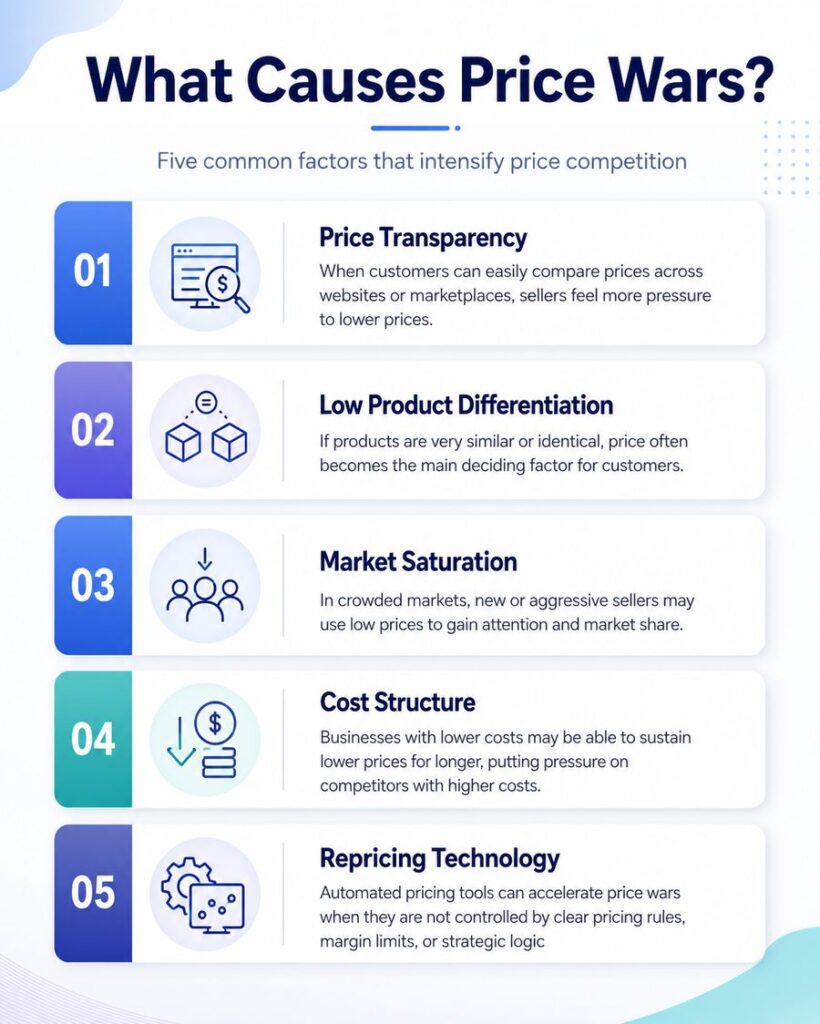
In ecommerce, price wars often occur because identical products are sold by different businesses on the same marketplaces. That’s why price is a significant factor for customers when deciding.
Price wars can be beneficial if you attempt at the right time with the protected profit margin. Otherwise, it may damage a business
Price War Trigger
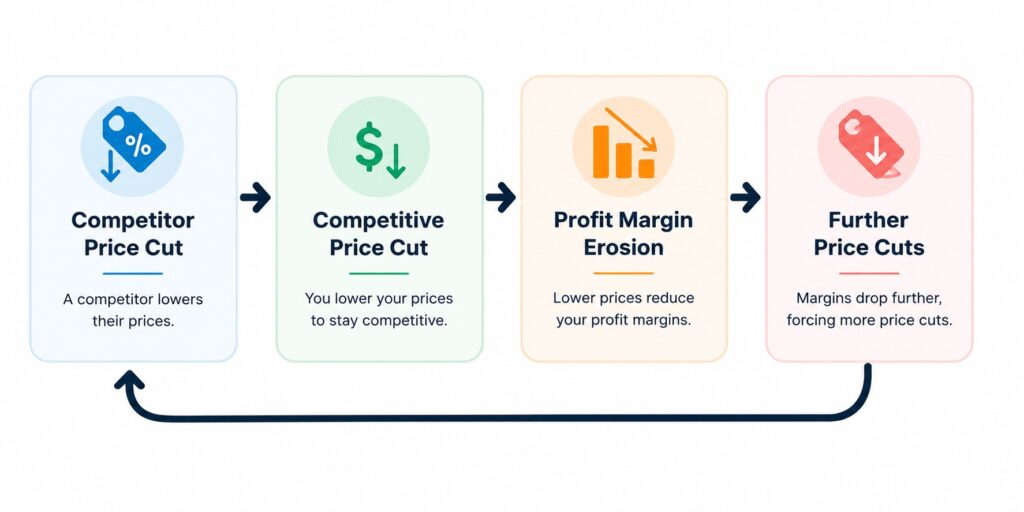
This price competition usually continues until prices stabilize, one or more players exit the market, or sellers shift their strategy away from price-based competition.
Types of Price Wars
There are certain versions of price wars.
Reactive Price War
A reactive price war happens when one seller lowers its price, and the market responds by cutting prices as well. This is one of the most common forms of price war in ecommerce, especially given that ecommerce businesses use price-tracking and repricing tools.
Predatory Price War
A predatory price war is a kind of hostile strategy when a big player intentionally sells at very low prices to push smaller competitors to decrease their profit margin and eventually push them out of the market. Once the competitor is eliminated, the dominant player may increase the prices again.

Promotional Price War
The name explains itself, a promotional price war is usually temporary and planned campaign in limited periods such as Black Friday, Cyber Monday, Christmas, or end-of-season sales.
Algorithmic Price War
An algorithmic price war happens basically between automated pricing and repricing tools. Due to AI’s development in recent years, agentic pricing softwares takes places of humand control and decision making process.
Price War in Ecommerce
Price wars are especailly seen in marketplaces like eBay, Amazon where several sellers may list the identical products. In these marketplaces, customers can compare prices with a couple of clicks. This aims to encourage businesses to compete on price to increase visibility and conversion.
Thanks to automated pricing tools, this process got fasten and can be applied without hustle. A single price cut by one seller may trigger acompetitors’ repricing rules i seconds. Thats why, pricing rules should be determined carefully in the first place. Without limitations, sellers may enter an unintentional race to the bottom.
For ecommerce businesses, this makes competitor price monitoring critical. Sellers need to know when to match a competitor, when to hold their price, and when to step away from unprofitable competition.
Risks of Price Wars
- Margin Erosion: Repeated price cuts reduce profitability and can make sales unsustainable.
- Brand Devaluation: If customers constantly see a brand competing only on price, they may start to perceive it as cheap or low-value.
- Race to the Bottom: When all competitors keep lowering prices, the entire market can become less profitable.
- Price Anchoring: Customers may become used to discounted prices and become unwilling to pay regular prices in the future.
- Reduced Long-Term Competition: In some cases, smaller businesses may leave the market, reducing competition and choice for customers over time.
How to Avoid or Survive a Price War
Avoiding price wars or picking your battles wisely can be a good strategy to protect your margins.
Invest in Differentiation
Differentiation is the key to keeping your customers paying more. Better service, faster delivery, stronger warranties, product bundles, loyalty benefits, or exclusive offers can help reduce dependence on discounts.
Compete Selectively
Identify strategic products, decide where to price match, and avoid racing to the bottom on every item.
This helps ecommerce businesses attract customers with selected competitive prices while protecting margins across the rest of their catalog.
Monitor Competitor Prices
Tracking competitor prices helps businesses avoid blind reactions. Instead of automatically matching every price cut, sellers analyze historical pricing actions, market trends and act accordingly.

Set Minimum Margin Rules
Repricing strategies should include minimum price or minimum profit margin thresholds. This prevents sellers from unintentionally pricing below profitable levels.
Use Rule-Based Dynamic Pricing
Rule-based dynamic pricing allows businesses to stay competitive while protecting margins. Instead of reacting emotionally or manually, sellers can define clear pricing strategies based on competitor behavior, stock levels, costs, and profit targets.
Why Price Wars Matter
Pricing is one of the most important pillars of your marketing stack. Pricing also affects customers’ perception of your company, quality, etc. Low prices may attract many price-sensitive customers; however, they may also harm your brand positioning. Don’t forget, winning the lowest-price position doesn’t actually win the market.
Sellers need to understand competitor price movements, define margin limits, and use dynamic pricing rules that support both competitiveness and profitability. With Prisync, ecommerce businesses can track competitor prices in real time, monitor price changes across channels, and use rule-based dynamic pricing to stay competitive without sacrificing margins.
Conclusion
A price war can help ecommerce businesses boost sales and attract customers, but it can also hurt profit margins if not managed carefully.
Instead of lowering prices across the entire catalog, sellers should compete selectively, protect their margins, and use pricing data to make smarter decisions.
The goal is not to be the cheapest, but to stay competitive with a sustainable pricing strategy.