

Let’s imagine you are a well-known hat manufacturer with numerous stores and resellers. And you have built a great product that is both waterproof and durable, even in harsh weather conditions like wind and sun. Also, it comes in many chic colors, making it an outstanding product for sports events as well. You calculated your costs. But can you set the retail price for this new hat line? When it comes to pricing products, both wholesalers and retailers struggle with which price point works best for each case. If you charge too little, you can leave your potential profits on the table. If you charge too much, you can lose your potential customers. Most business owners struggle to find that sweet spot. What will the retail price be, and how much will it come down to set the wholesale price?
Whether you’re a wholesale seller, a retailer, or both, like in our example, one thing is clear: you need to know how to calculate average and profitable prices. The aim of this calculation is simply to determine the profit amount that keeps your business healthy. So, let’s go through the common pricing strategies that increase profits, the difference between margin and markup, retail price calculation, and how to find the wholesale price.
What is the Difference Between Wholesale and Retail Pricing?
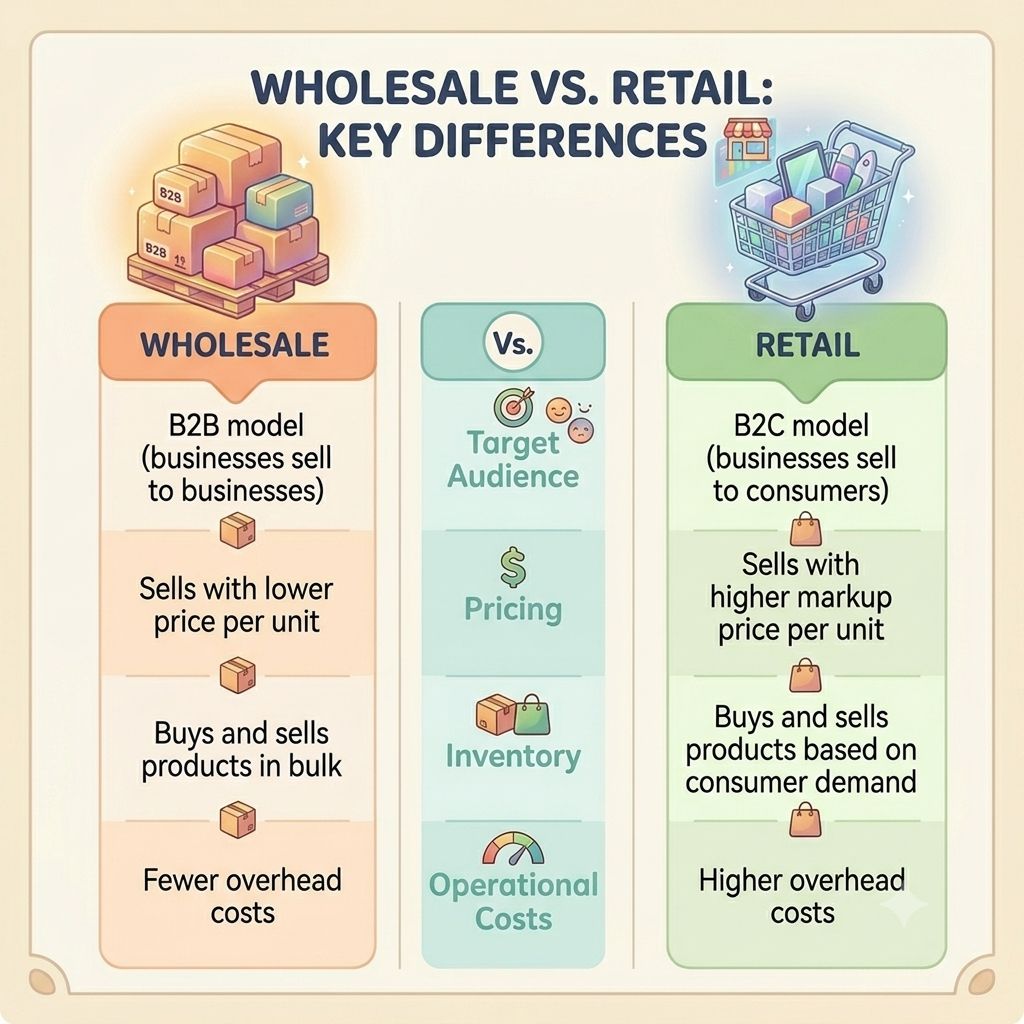
What is Wholesale Price?
Wholesale price is the amount a manufacturer charges its retailers, distributors, or resellers for bulk purchases of its products. As manufacturers sell their products to retailers at a discount through bulk purchasing, manufacturers aim to cover their production, labor, and overhead costs while applying the desired profit margin, and retailers can benefit from bulk buying by increasing their profit markup.
A single wholesale order might help businesses achieve higher levels of sales in a single go that would have taken weeks of individual retail sales. Since there is no guarantee that the retailers can cover their purchase, and it takes time to sell the products, wholesale buyers expect a discount for this commitment. This is why your wholesale pricing formula needs to reflect that trade-off while still protecting your production, labor, and overhead costs.
What is Retail Price?
The retail price is the price consumers pay to acquire products and services. In this case, after buying products in bulk, retailers, distributors, and resellers add a markup and sell them to end consumers. The amount of markup applied depends on the specific retailer and their target customer characteristics. For example, if you have a physical store, there might be additional costs, such as rent and employee expenses, that increase the product’s retail price. On the other hand, if you are an online merchant that practices dropshipping, the cost would be lower, and your customers can get a better deal.
Components of Any Pricing Strategy
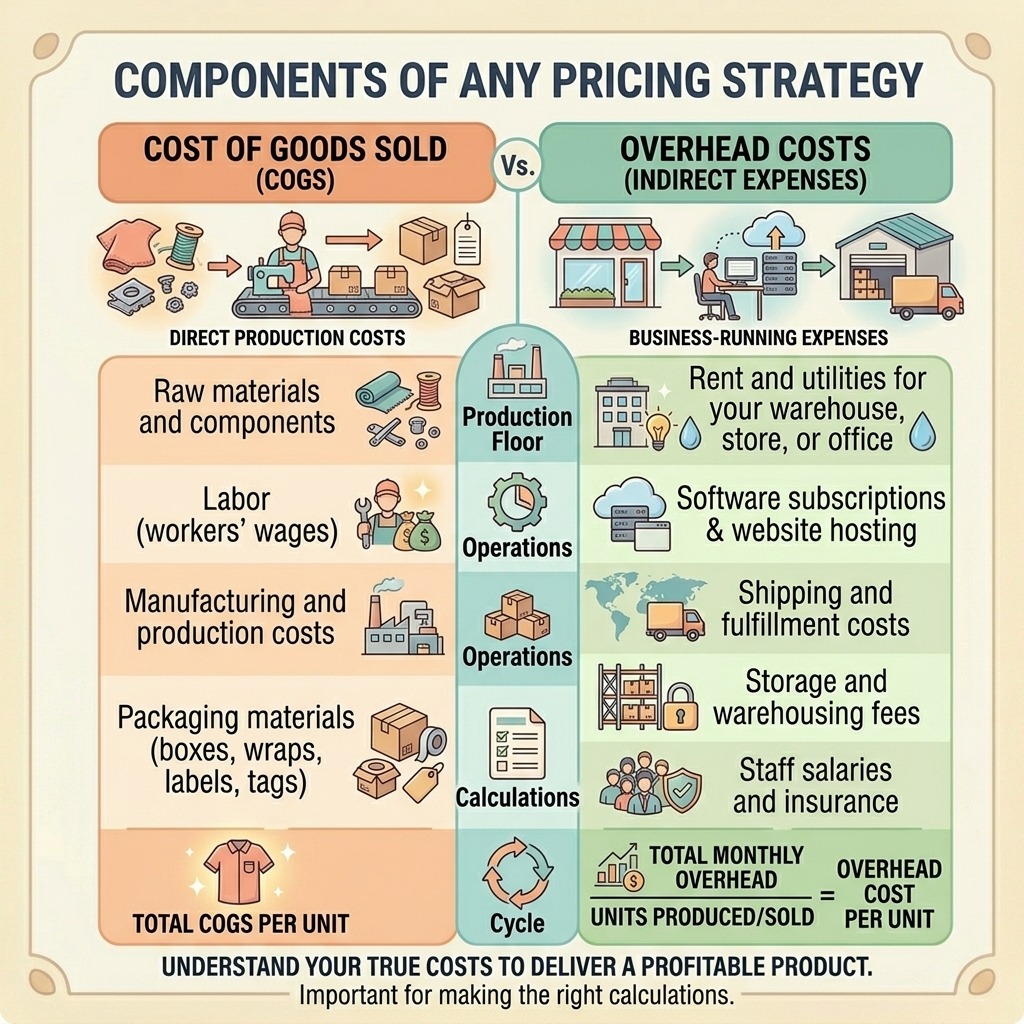
Whether you are setting a wholesale or retail price, the reasoning is the same here: you need to understand how much it costs you to produce and deliver your end product as a cycle.
Cost of Goods Sold (COGS)
COGS is your starting point. It includes every single cost that is related to producing one unit of your product:
- Raw materials and components
- Labor (workers’ wages)
- Manufacturing and production costs
- Packaging materials (boxes, wraps, labels, tags)
Overhead Costs
Then there come overhead costs, including your rent, salaries for store staff, etc., basically all the indirect expenses that keep your business running:
- Rent and utilities for your warehouse, store, or office
- Software subscriptions (Also website hosting costs for online retailers)
- Shipping and fulfillment costs
- Storage and warehousing fees
- Staff salaries and insurance
To calculate overhead cost per unit, you can divide your total monthly overhead by the number of units you produce or sell in that same period.
Profit Margin vs. Markup
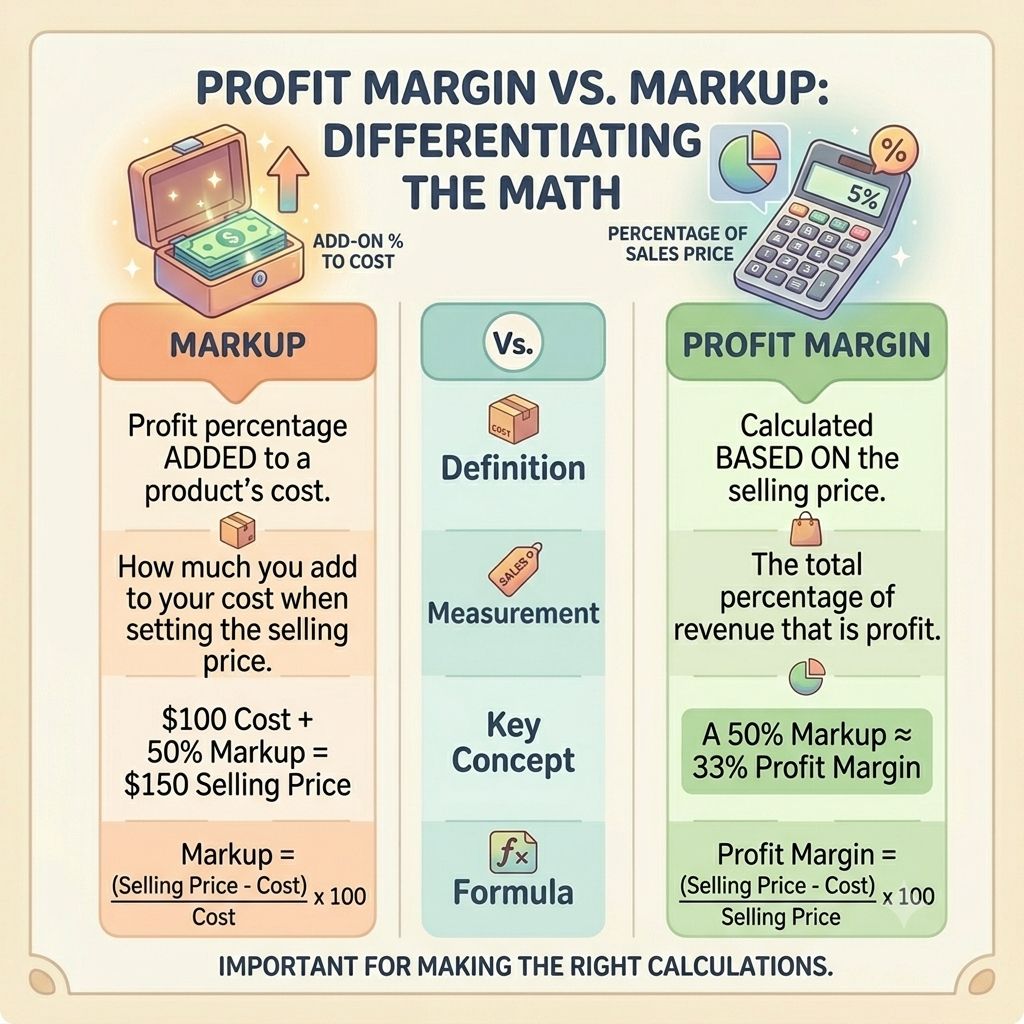
These two terms can be confusing in ecommerce but they measure very different things. Markup is the profit percentage added to a product’s cost. It determines how much you add to your cost when setting the selling price. For example, if you set a 50% markup and your product costs you $100, you would need to sell it for $150. However, the profit margin is calculated based on the selling price. A 50% markup on the same product equals approximately a 33% profit margin.
Markup = (Selling Price – Cost) / Cost x 100
Profit Margin = (Selling Price – Cost) / Selling Price x 100
When setting pricing targets, it is important to be aware of the two concepts to make the right calculations. And you can always get help from our Markup Calculator.
How to Find Wholesale Prices
First, wholesalers need to calculate total costs, including COGS and overheads. Then, they need to determine their minimum acceptable profit margin according to business goals which will be the number that goes into the formula below. And, they can calculate a product’s price like this:
Wholesale Price = Total Cost of Materials + Total Cost of Labor + Overhead + Profit Margin*
*Profit Margin here refers to the desired profit amount per unit, not a percentage
Let’s go back to our hat manufacturer and assume producing one waterproof, sun-resistant hat costs:
Material cost (waterproof fabric, brim structure, dye): $6
Labor cost: $3
Overhead (factory rent, utilities, packaging): $2
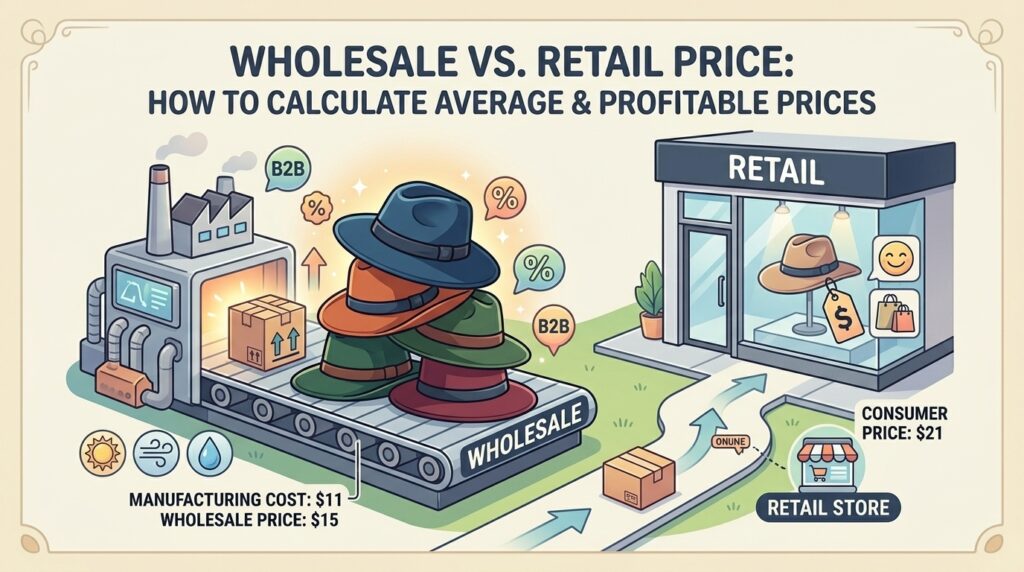
That brings the total cost to $11 per hat. If the manufacturer wants to earn $4 profit on every unit sold to retailers, the wholesale price becomes:
Wholesale Price = $6 + $3 + $2 + $4 = $15
Absorption Pricing, also known as full costing, is a reliable wholesale pricing method in this case. In absorption pricing, manufacturers ensure that each unit sold covers both variable and fixed costs, aiming to prevent the common mistake of pricing based solely on materials.
How to Calculate the Average Retail Price
Once you know your total costs, the next step is choosing a markup according to business goals, whether that’s maximizing profits, or staying competitive. You can calculate a product’s average price using the formula below:
Price = (Material Cost + Labor Cost + Overhead Costs) x (1 + Markup)
Let’s continue from our example. Now the retailer buys these hats at $15 each and wants to apply a 40% markup to cover store rent, staff, and their own profit:
Price = $15 x (1 + 0.40) = $21
So the hat that cost $11 to manufacture ends up retailing for $21 which ends up reflecting both the manufacturer’s margin and the retailer’s markup.
One common scenario is that retailers usually set a higher profit margin to cover their costs in the beginning, capitalizing on the hype around a newly introduced product. So, the first selling price of the product can be well above both the wholesale and recommended retail prices. But if it is not a premium brand to begin with, retailers may prefer to stay as close as possible to its list price, ensuring they cover their costs and earn a profit from sales.
The Keystone Pricing Method
Keystone pricing is precisely doubling a product’s actual wholesale or production cost and setting that as the new retail price. According to the keystone pricing definition, you will earn a 50% profit on every item you sell. As a starting point, it is more straightforward and practical for generating higher profits for your unique products.
There is a traditional retail rule of thumb for the keystone pricing formula:
For retailers who manufacture: retail price = cost of manufacturing the product or service x 2
or
For resellers: retail price = wholesale price x 2
So, for example, you have a slippers shop that sells slippers and socks, and the wholesale price of one pair of slippers is 10 dollars. Then the retail price of these slippers should be 20 dollars, since your keystone markup is 10 dollars. If demand for a product increases, the product’s selling price should also rise to leverage customer demand and raise profit margins. Also, practicing competitive pricing helps retailers to determine the positioning of their items in the market and set the right selling price, while still generating a profit by monitoring competitors.
Manufacturer’s Suggested Retail Price (MSRP)
The manufacturer’s suggested retail price, also known as the recommended retail price, is the price the manufacturer suggests the product should be sold for. As long as you respect the recommended retail price, you can experiment with whichever pricing strategy best fits your business goals and start turning a profit. Remember, competitor analysis and price elasticity also matter when setting profitable prices.
3 Proven Pricing Strategies to Maximize Profitability
Here are three proven retail and wholesale pricing strategies:
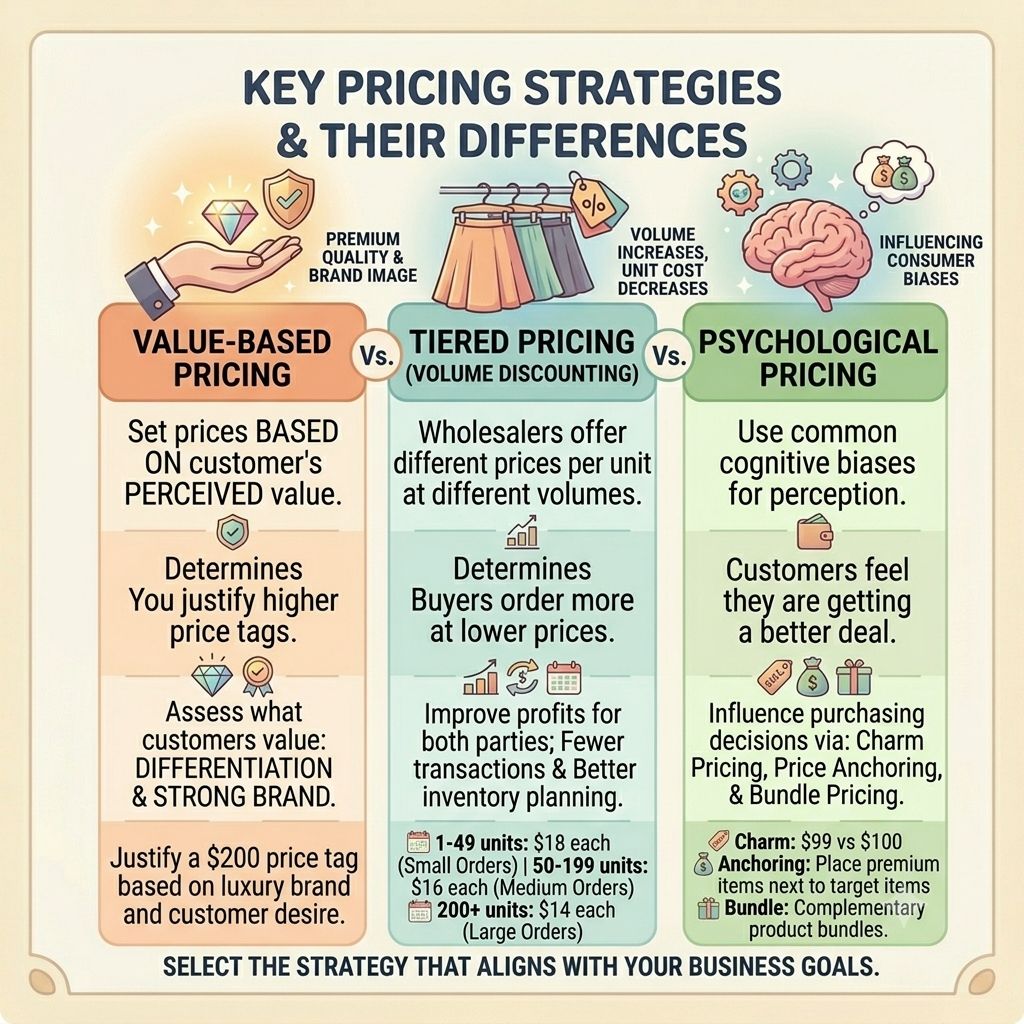
Value-Based Pricing: Value-based pricing is an approach that allows businesses to set prices based on the customer’s perceived value rather than the cost of production. Product differentiation and a strong brand image are key to this value-added pricing strategy, as consumers will be willing to pay for your products. You can justify higher price tags by assessing what customers value in your products or services.
Tiered Pricing (Volume Discounting): Tiered pricing can give merchants a great advantage in wholesale. Since wholesalers can offer different prices per unit at different volumes, merchants can order more at lower prices. Thus, both parties, retailers/resellers and wholesalers, can improve their profits, go through fewer transactions, and have better inventory planning.
Let’s say you’re a clothing manufacturer. If you price your skirts at $18 each for small orders (1–49 units), $16 each for medium orders (50–199 units), and $14 each for large orders (200+ units), you encourage wholesale buyers to purchase more. Each tier still covers your costs and margin targets, but the buyer feels like they’re getting a better deal the more they buy.
Psychological Pricing: Psychological pricing techniques use common cognitive biases, making customers feel they are getting a better deal or more value for their money and influencing their purchasing decisions. Charm pricing ($99 vs $100), price anchoring (placing a higher-priced item next to the one you want to sell), or bundle pricing (bundling complementary products) can encourage your customers to purchase more products.
Common Pricing Mistakes to Avoid
Many businesses assume that the lowest price always wins the most customers, but if you aim to establish customer loyalty, undercutting your prices to attract buyers can hurt your profits without building customer loyalty. Instead of offering constantly cheap prices, it’s often better to hold a price point that reflects your product’s value and it is acceptable to lose some of your customers if you decide to keep product prices at a certain level. The good news here is that the move will likely lead to you winning loyal customers who will make repeat purchases, because they’re choosing you for quality or reliability, not just for the lowest price. Focus on loyal shoppers who are willing to continue purchasing from you. Always test your customers’ reactions while testing out different price points. To stay ahead, continually monitor the market and act dynamically.
Many businesses calculate production costs but end up forgetting to factor in the costs that do not show up on the production line, such as transaction fees, packaging costs, return processing expenses, and marketplace fees. Since these costs can add up fast, account for them to avoid margin loss.
Failing to account for price elasticity and customer demand also affects your profits. Price elasticity is just another way of saying: how much do your customers change their buying behavior when prices go up or down? For some products, a tiny price hike can reduce demand. For others, customers are willing to pay higher prices. It’s important to know where your products fall on this scale. Try simple experiments like changing your prices for a short time, looking back at how sales changed with different prices, or just asking your customers directly. Even if your data isn’t perfect, it can help you make smarter pricing decisions. And don’t forget to keep an eye on your competitors since knowing what they charge helps you understand how tough the market really is.
Conclusion
Deciding which price points best serve both customers and merchants can be hard, and manufacturers also aim to cover their expenses and maintain their brand image, so having profitable prices can be challenging in the world of ecommerce. As a retailer, once you know your true costs, profitability depends on how you try different pricing strategies that align with your business goals to stay competitive and keep your prices dynamic, reflecting your customers’ expectations and market demand. Remember, you can also use a retail and wholesale price calculator to model your numbers before committing to a price point. While wholesale and retail pricing follow different parameters, profitable pricing results from knowing your numbers, understanding your market, and applying the right strategy for each channel.
Visuals are created with Gemini.


